Thursday, February 27, 2014

Chris Carpenter at the Shakespeare Theatre

Chris Carpenter is a dyer at the Oregon Shakespeare Festival. She is participating in an A Ha! funded artisan exchange at The Shakespeare Theatre Company of Washington DC.

Greetings from Washington DC, 

It's snowing!


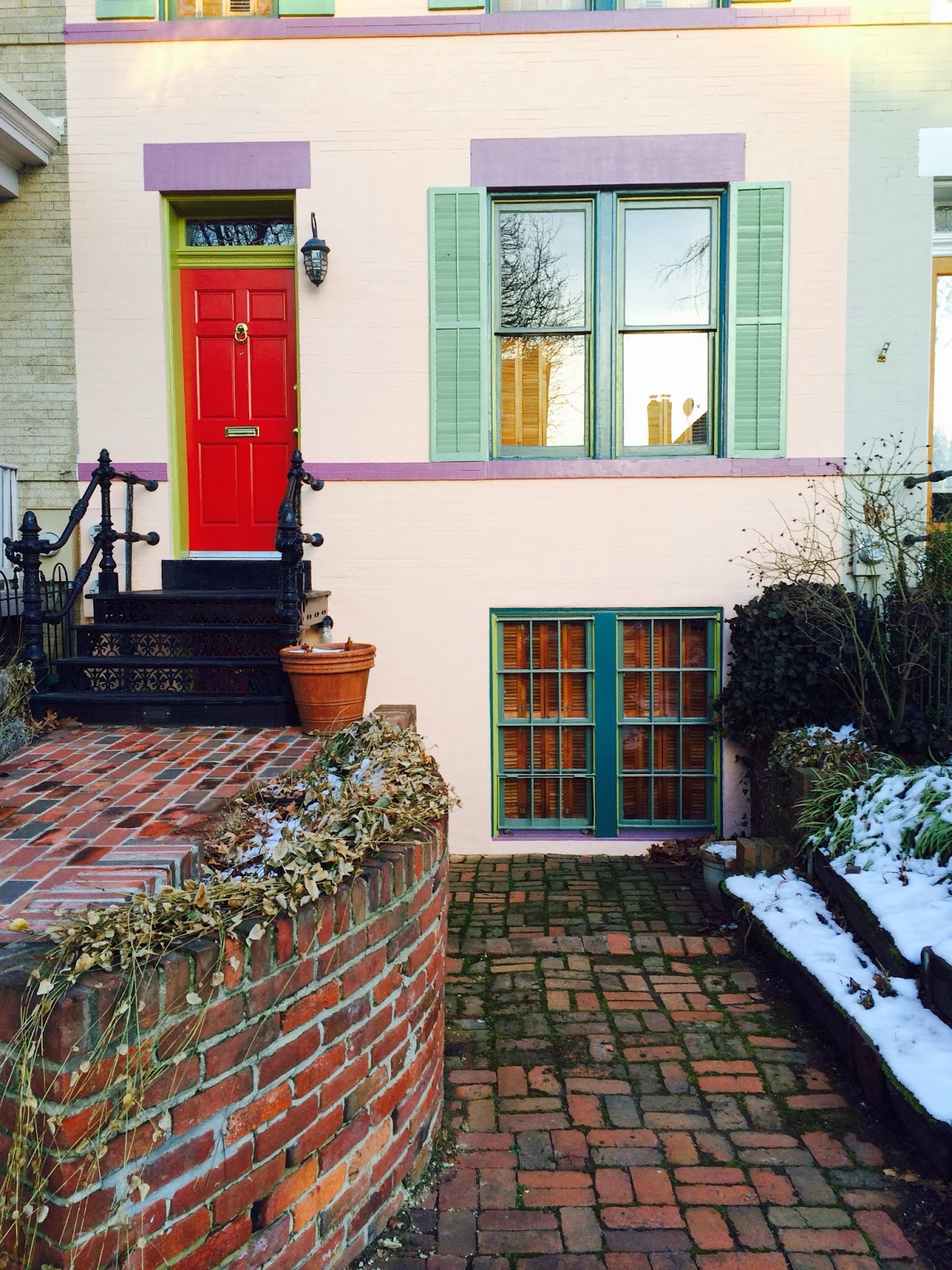
It's beautiful. Here is my little apartment two blocks from the costume shop.


The first thing that hits you upon entering the Shakespeare Theatre's costume shop is the amount of SPACE.  I imagined a shop in an urban area would be very cramped. What a surprise having the freedom to move around without running into anybody. The cutters' tables are huge. Demonstrating this is Julie Rose, a former OSF employee.


And, the dye shop has some very serious gloves; full length and very heat resistant. 


Wednesday, February 19, 2014

Mike Hamer at OSF: Week 2

 I have now been in Ashland for two weeks working in the scene shop for OSF.

I continue to work on a few notes as they arise for the shows.  One of the greatest challenges of operating in a repertory schedule is to find the time and opportunity to do set notes. Many of those notes need to be done while the scenery is in its proper place on stage.  However, in a rep schedule, you might have a few precious hours to accomplish some notes in the morning before a rehearsal begins, then there is another rehearsal that often doesn’t end until 11:00 pm or later, and then the set is shifted offstage and another one is shifted on.

I was tasked with constructing some rolling platform wagons for the show Water by the Spoonful.  These are simple platforms constructed from 2x4 and plywood.  Some of these wagons will carry a raked platform, some a projection screen, some both.

In the foreground of this picture is a large platform that will carry a projection screen.  In the background is a raked platform on its rolling wagon:


This is a picture of a projection screen on its rolling wagon.  The projection screen material will be applied along the large angled rectangle:


This is a picture of a ground plan for Water by the Spoonful:


There are 10 large rectangles, some of which are raked platforms; some are shorter platforms that aren’t raked. There will be an LED lighting effect in the platforms.  Nearly 600 holes, about 1” in diameter,  will be covered by small plexiglass discs with an LED underneath to create different light configurations on the floor.

This picture illustrates a method for deadening the sound of people walking on a platform. This is the underside of the platform:


Most sets are insulated with the same kind of fiberglass insulation used in the walls in a house.  This insulation is made of RECYCLED JEANS!!  That is awesome.  Since these platforms are going to be carried and handled during a changeover, it is a much nicer material than fiberglass (but maybe a bit more expensive.)

This is an overall picture of the shop:


You can see how tight the working space is, and how quickly it can get cramped.  I think that everyone is very excited to move to OSF's new scene shop, where they will be able to set up the full set for a show before it goes into the theatre.  Being able to ensure that every piece of a set fits together and works properly, with all the tools and benefits of the shop at hand, before installing it into the theatre is a great advantage. Some people are concerned about not being so close to the theatre complex. The current scene shop is a block away from the theatre, the new shop is about five miles away.. Being able to walk to the shop and get the tool or material that you need to accomplish a note is very convenient.

This is a picture of a bed frame, that was printed ON A 3D PRINTER!!  So awesome!!!


I believe it is for Richard III.  This awesome piece of technology is being used by OSF to create model pieces.  A scenic designer (or maybe assistant designer, or assistant technical director) creates a 3D drawing, and then prints it.  The designer can then paint it accordingly.  The shop also printed some line weights for The Tempest.  They needed to resemble light bulbs that were already part of that scene, so they printed hollow light bulbs and filled them with ball bearings.  I am also told that there is an attachment for the printer, called the “digitizer.” This scans an object, and will then either reprint it or create a drawing of it for manipulation.

The Elizabethan and Bowmer Theatres back up to Lithia Park.  This is a beautiful and lovely park.  As I was walking through the park on Saturday, I thought it would be a great place to have picnic dinner before the show.  This idea was inspired by the long standing tradition of “tailgating” at the Santa Fe Opera.  This tradition started years ago, and has since taken many shapes.  Some people arrive and find a picnic table or set up their camp chairs and have a sandwich, cheese and crackers, and a bottle of wine.  Others arrive to a fully catered three course meal with silk table cloths and fine china.  The opera decided to try and take advantage of this, and teamed up with their catering company to offer “box meals” for an additional price to the ticket for the show.  When they arrive, patronspick up their dinner and enjoy it in the wonderful outdoors overlooking the Sangre de Cristo mountain range.  I wondered if OSF could do the same thing, team up with a local catering company over the summer and encourage their patrons to enjoy a picnic in the park, maybe even provide a blanket that they could borrow and then return in a hamper before the show.

This coming week I think that I may be observing or taking part in a scenic changeover.  In my next few weeks I hope get a closer look out the automation systems. 

Monday, February 10, 2014

Mike Hamer at the Oregon Shakespeare Festival

Greetings!  My name is Mike Hamer, and I am participating in the Oregon Shakespeare Festival’s Artisan Exchange Program.  I am from Denver, Colorado and have lived there my entire life.  I studied Technical Theatre at the University of Northern Colorado in Greeley, Colorado.  While attending UNC, I began working as an over-hire carpenter at the Denver Center Theatre Company.  I also started working  for the Santa Fe Opera over the summers.  Since I graduated in 2009, I have been working for both companies.
From September through mid-April, I work for the Denver Center Theatre Company as a carpenter, building scenery for their 11 show season, which is produced in three theatre spaces.  The Denver Center does not operate in a repertory schedule.  

From mid-April through August, I am the Stage Carpenter for the Santa Fe Opera.  Basically, I am in charge of all of the stage operations that involve changing over one set to another and for scenery shifts that occur during the performances.  The opera operates in a repertory schedule that seems similar to that of the Oregon Shakespeare Festival, but within one stage space.

I have always been interested in working for the Oregon Shakespeare Festival, and I am extremely excited to be participating in this program. I will be in Ashland for five weeks working in the scene shop building scenery.  I am also hoping to get some exposure and experience with how they operate and construct their automated lifts, trap doors, tracking scenery, and turntables; as well as watching or participating in a scenery changeover from one show to another show.  This week there are several shows in the tech rehearsal process.  I have been working on notes for these shows in the morning before the rehearsals start.  The first few days I was working on Comedy of Errors in the Thomas Theatre, and the later part of the week I was working on notes for The Tempest in the Bowmer Theatre.  For The Tempest I worked on stretching a drop to get the wrinkles out of it, and creating a light bounce to help reflect the light on the back of a translucent drop.  I also started constructing platforms for a show called Water by the Spoonful.

The Oregon Shakespeare Festival has just built a new production building that will be the new home of the scene shop, paint shop, prop shop, and costume rentals.  I was able to tour this impressive facility a few days ago, and I must admit that I am jealous.  They have a huge new scene shop area that will be great for putting together finished sets and working on larger scenery.  The paint shop is massive as well, with tons of room to paint and layout scenery and drops.  

I am particularly interested in metal working and automation. One very interesting thing about OSF is that they have an automation department.  Both DCTC and SFO have a solid group of carpenters that are able to build scenery and also construct and implement automation systems.  Here, at OSF, there is an automation department that works closely with the carpenters, but ultimately only deals with the automation systems.  The company also writes the software that controls the motors, which is very unusual for theatres to do.  I can’t wait to learn more about it.


Ashland seems to be a small, quaint town. There is the main downtown area that has a number of shops and restaurants, and at the center is the Oregon Shakespeare Festival.  I am excited to be visiting this town and area.  I am very excited to experience more of the theatre festival, as well as some sightseeing nearby.

Wednesday, January 22, 2014

Donna Memmer at the Alliance Theatre


I arrived in Atlanta on Sunday January 5th and took the MARTA train into midtown.  Easy, fast, cheap and clean.  I was immediately thrown into the Alliance Theatre’s production of The Geller Girls, finishing the clothes needed for tech rehearsals. Costumes are designed by Linda Roethke.  The play is about two sisters (one a dressmaker), their father who runs an emporium/dry goods store, his wife (stepmother to the girls) and a young suitor who works in the dry goods store.  The play takes place during the 1895 Cotton Exposition held here in Atlanta's Piedmont Park, just blocks from the theatre. 

The Alliance Theatre costume shop has a staff of 13-15.  Carol Hammond is the Shop Manager and she is also the assistant costume designer for the main stage productions.  Everyone is highly skilled.  In this smaller shop scenario, everyone has to pull their weight and then some.  They all cross over into costume crafts, working on everything from millinery to leather.  What I find impressive is how fast they switch gears.  So far I have only been a "sous" stitcher.  I'm not sure that I will build anything.  The cutters seem to do all the major construction. Not having to translate for the stitchers saves time. They pattern, cut, stitch and do most of their own R & D. 

During my first week, temperatures dropped into the single digits at night with a negative wind chill factor. The temperature stayed below freezing for 60 hours, then up to 60 degrees for a day followed by a flash flood warning and tornado warning.  All within 7 days.  And we thought Oregon was unpredictable! 

The Alliance has two stages.  The main stage seats over 700 with a balcony.  They are going to remodel and reduce the house size to reduce royalties. The smaller space is The Hertz, a black box theatre that seats 200. 


Alliance Theatre

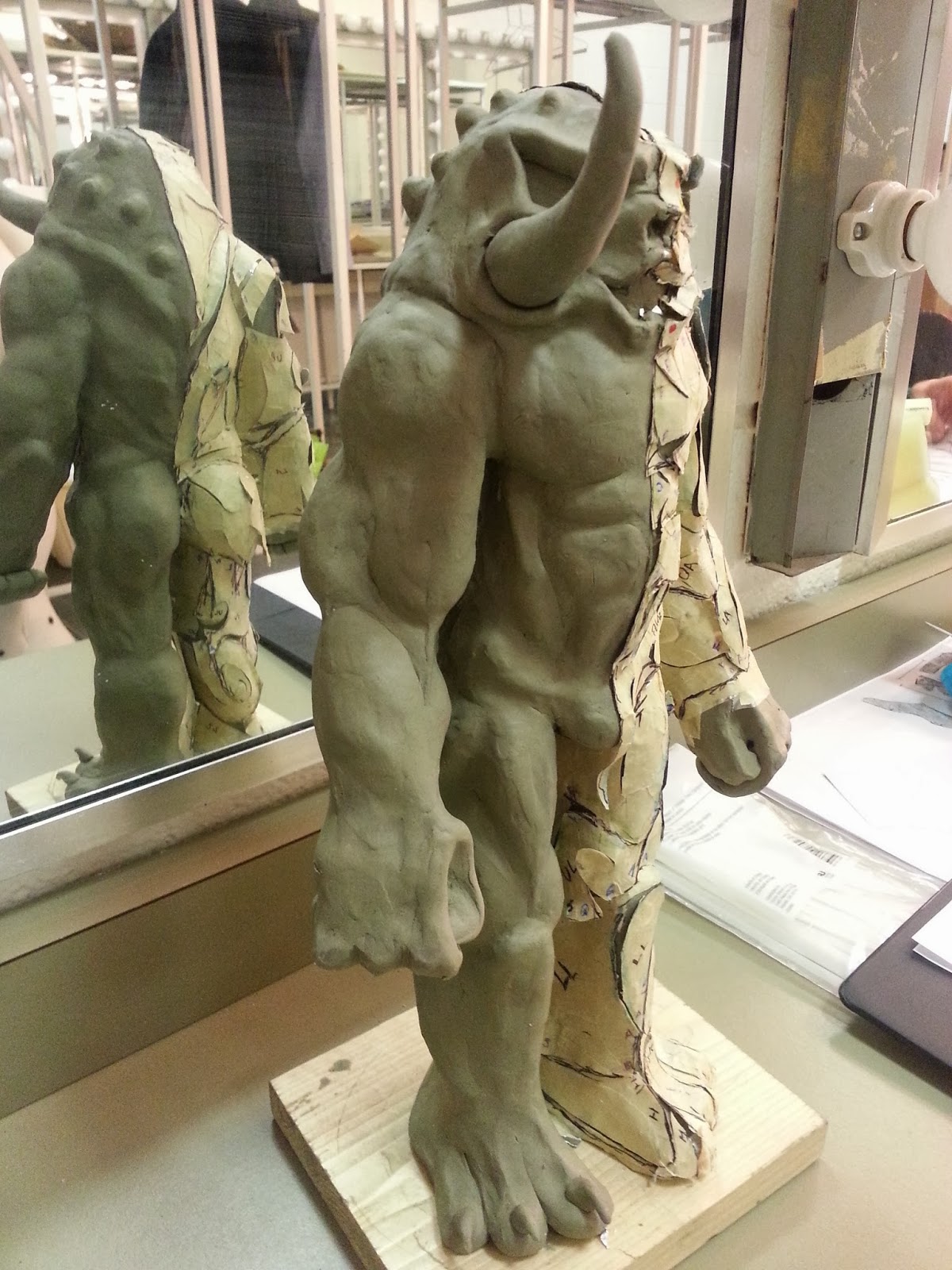
The next show scheduled for The Hertz is a new play that won an annual contest. In Love and Warcraft takes audiences into the gaming world, complete with avatars. That show previews January 31, the night before I leave. It has a tight tech schedule, with clothes onstage on January 28th. These pictures are for one of the play's costumes.  Our process was to build a reduced-size clay model, pattern the model with paper, and then blow up the pattern pieces to full size using a projector.  The full-size pattern was then cut out of foam and glued together.  Soon, this avatar will have another layer of foam "skin" applied, painted and textured. Usually, a full-size creature (such as a sports mascot) has fur instead of skin, so there's no need for minute detail. Scotty, the resident puppet builder here, said this is the most muscular form he has ever built.


The Geller Girls tech was challenging. Various issues with the set could not be resolved before the end of tech rehearsals and we only got to do one run through in costumes before the evening preview.  That would be incredibly stressful for a dresser at OSF, but the Alliance presents more preview performances than OSF does, which allows for more time to solve problems. At the top of the OSF season, three plays are teching, dress rehearsing, previewing and opening in rotating rep, so the sets are constantly shifting on and off stage. At the Alliance, the set of the current show is always on stage so crews can work things out in the afternoon. 

I had the opportunity to attend the Alliance’s Company Call and learned of their plan to remodel both the public and backstage spaces.  I wonder how OSF could ever remodel or upgrade the Bowmer without shutting down for a season? The Alliance plans to continue performing in The Hertz while producing main stage shows in various venues around the city (ah, remember the Bowmer Tent?*)  I was so surprised and delighted by this solution.  If only OSF had those opportunities.  My artisan exchange is making me realize just how challenging the OSF environment is.  We're like Galapagos turtles: we have adapted to our closed-off environment to be our own breed. 

The Alliance is unique (at least to me) in that it is part of a larger arts organization.  The Woodruff Arts Center is the umbrella for The High Museum of Art, The Atlanta Symphony and The Alliance Theatre.  I think this brings a sense of calm to the work because there's someone to catch you if you fall.  The Woodruff Center provides IT, Box Office, Custodial and Building Maintenance and there are challenges when those shared resources do not serve The Alliance’s specific needs and vision. 

Woodruff Arts Center

High Museum of Art

I wish I had more time to get out and explore Atlanta.  I've just begun to get comfortable and understand how to get around.  Yesterday and today, I set out on foot to explore. I walked over to the Midtown Art Cinema to see 12 Years a Slave, catching up on the Oscar nominations.  The 40-minute walk took me through the south end of Piedmont Park where the grass was brown.  I’m not sure if that's due to water conservation or to the fact that it froze for three days.  Must be beautiful in the spring.  Then back to my room to catch the last three quarters of the Seahawks game.  Today I went for a burrito at Willy's located on Piedmont at 12th, as suggested by my friend Courtney (an Atlanta native.) The weather was so nice, I sat outside in my short sleeve shirt.  Then I toured the Margaret Mitchell House on Peachtree Street (the main Peachtree Street; there are MANY).  Mitchell and her husband had an apartment on the lower floor and this is where Gone with the Wind was penned.  Her husband challenged her to begin writing a book while she recovered from a car accident.  Prior to that she had been a newspaper reporter writing under the name Peggy Mitchell.  She died at the age of 49 when she was hit by a car while crossing the street.  It was her wish that the original manuscript of Gone with the Wind be burned upon her death and her husband obliged.  She also tore down the family home where she grew up, fearing it would be turned into a museum.


I have noticed that drivers really like to honk their horns in Atlanta!  Not the "Hey be careful" horn, but the "Hey you're in my way and I don't care if it's not your fault" horn.  Otherwise people are very friendly and polite.  But they will run you over, so watch out!

Next weekend I plan to take a backstage tour of The Fox Theatre, a beautiful old road house.  So few remain.  Then maybe the Georgia Aquarium.  I must see the Botanical Gardens before I leave too.  Too many restaurants so little time.

*The Bowmer Tent was a temporary performance venue erected when OSF’s Bowmer Theatre was unexpectedly closed for emergency repairs.


Monday, December 2, 2013

Danielle Richter: Tech Tech and More Tech

The past couple of weeks have been crazy. In three weeks, we’ve had tech for two shows and opened two shows. I’ve never done tech back to back like that before. At the Oregon Shakespeare Festival, we normally don’t work on two shows that open back to back. At Milwaukee Rep, as soon as we got into Noises Off tech, we were building, setting, and styling wigs and facial hair for A Christmas Carol and went into tech the next week. I don’t know how Lara (the wig master) does all of this stuff by herself normally. She’s amazing. It was a really good experience to work on two shows at the same time. I definitely got quicker at setting wigs. Lara and I got on a roll with the Christmas Carol wigs, and finished everything with a little time to spare. I set and styled most of the men’s wigs for Christmas Carol. I learned a couple different types of sets for men’s wigs, including a pin curl set. It was a lot of fun to figure out which sets created which styles from the research pictures.  This is a picture of a men’s wig in a set that I did. 

As always the weather was ridiculously cold. There was one day where it got down to 7 degrees and below 0 degrees with the wind chill… Needless to say I stayed indoors as much as possible during that time. One morning I walked to work when it was 19 degrees outside, and people were lined up on the streets waiting for a parade to start. It was 8:30 am and the parade didn’t start until 10:00am. My legs were numb by the time I got to work, and there were people sitting outside like it was 70 degrees and sunny. I will never understand how people can sit outside in that cold, but more power to them. On one day, I was able to go outside in just a T-shirt for about 5 minutes. I was super proud of myself and of course had to take a picture to document the moment. It may have been about 40 degrees, but still for a Texan that’s pretty good. :) 


Despite the cold, this city is really beautiful. I love the architecture of the buildings. It snowed for a few days last week and it was really pretty. Milwaukee has a bunch of Christmas lights already set up, so the snow with the lights made the city that much more beautiful. They also have a Christmas tree set up in what I’m guessing is their Times Square.


One of my adventures over the past couple of weeks involved going to a place called Comet Cafe with a few people I work with in the costume shop. The Cafe apparently serves baskets of bacon on Sunday afternoons. I didn’t get to experience this, but the idea is pretty awesome if I do say so myself. I got an omelet that was pretty spectacular. They also serve coffee that tastes similar to Noble coffee (a small coffee shop in Ashland), so it was a little taste of home. Ill definitely be going back again before I leave Milwaukee. 

I only have two more weeks left in my program, and am super excited to see what else I can learn in that time. Over the past four weeks I’ve learned so much and feel as though I’ve gotten more comfortable and confident in my skills as a wig artist. I’m excited to get back to OSF and apply everything I’ve learned and practiced while here in Milwaukee. I’ll be sad to leave all the amazing people and friends I’ve made here though. 


Thursday, November 14, 2013

Danielle Richter: The Coldest Place on Earth with the Best People on Earth.

Being from Texas, I have a different definition of the word “cold” and “winter.” I thought living in Ashland, Oregon, working for Oregon Shakespeare Festival, I’d experienced cold weather. Ashland is nothing compared to Milwaukee… In my first week working at Milwaukee Repertory Theater I feel like I’ve experienced it all weather wise. My first day it was 40 degrees and pouring rain, and the next day it was 45 and sunny. It’s been down in the 20s and snowing, and then there is the  wind coming off the lake that will make any day feel like it’s 20 degrees colder than it really is. Needless to say, it’s been an a adventure every time I walk out the door to walk to work.


All crazy weather stuff aside, I’m having a really awesome and positive experience working at Milwaukee Rep in the wig room. Milwaukee’s wig room is completely different than the one at OSF. First off, they only have one wig person to OSF's eight. Lara, their wig master, does everything herself (with the occasional help from costume interns or, on the off chance they have it in their budget, an over-hire wig person). That woman is a superstar. I love being somewhere where I feel like I’m really helping. It was my goal to get more experience building and ventilating wigs during this exchange. So far that’s all I’ve been doing since I’ve gotten here, (which is awesome.) I’ve been working on wigs for Noises Off and soon I’ll move on to Christmas Carol. I already feel like I’m getting faster at tying those tiny knots of hair. It’s also been nice to exchange information about the different styles of wig building I know of, and the ones that Lara uses in her shop. Second big difference is that their wardrobe people double as wig run crew, compared to OSF who has wig staff members assigned to every show. I really admire all these people who work in so many different areas within the theater.


I have to say I really love the people I’m working with here at Milwaukee Rep. Everyone in the costume shop is so nice, and I love working with the Lara. I’ve meet a lot of the interns who, like me, are new to the company. They invited me out bowling last Monday, which was a lot of fun. Something I love about theater in general, is how small of a business it is. It seems like every person I’ve meet here at the Rep knows at least three of the people I work with at OSF. I hope to meet even more of the company in my next 5 weeks.

I’ve had one adventure exploring the city last weekend (since the weather was nice enough to go out in). I spent most of my day at the Milwaukee Art Museum, which is an amazing building. The building was designed to look like a sail boat, and has “wings” that open in the morning and close at night. It was quite the thing to look at. 

On the inside of the building, there are these giant glass walls that overlook the lake. It was so beautiful outside that day, you could see for miles. I sat for a pretty long time just looking out at the water.


My favorite artwork in the museum was defiantly an exhibition they had of Thomas Sully’s art called Painted Performance. They were beautiful, and most were what they called “subject pictures” that centered around theater, literature, and fairy tales. There were about 80 altogether. My favorite was one called “Little Nell Asleep in the Curiosity Shop”, which was oil on canvas painted in 1841. I’m so glad I had a chance to visit this museum, and I’m so happy to be spending time in Milwaukee at the Rep despite the cold.


This is the view from the window in the wig room. 


Monday, July 22, 2013

Kate Lucibella: Automation and the Pacific

This past week I was lucky enough to spend some time with OSF automation programmer Jennifer Hanson and electrical designer Ryan Poethke.   Jennifer was kind enough to take me through the typical OSF automation training as well as a walk-through of the operating system as well as the physical pieces that are used on a regular basis.

The software and operating system are developed entirely in house so the program can be designed and tweaked to do exactly what is needed of it.  There were some similarities between the system we use at STC (Raynok) but for the most part it was a completely different way of looking at automation.  I found the OSF program to be very intuitive and very user friendly.  After only spending about a half hour with the program I found I could easily navigate around the menus and caught onto programming pretty quickly. Unlike the Raynok system, there aren't really any drop down menus but pop up menus that can move around the home screen that allow you to look at different axis’ and cues and all the information for each.  The biggest difference for me what once a cue executes, the program automatically advances to the next cue.  On a Raynok system you have to manually advance to the next cue.

So what happens if you have to rerun the cue you just took? There’s a button for that! Here’s a picture of the automation console: 


The “re-run-current” button allows you to retake the cue that was just executed.  In order to take any cue on the console you need to be holding down the “enable” button. So in order to execute a cue, you need to hold down the enable button and then push the “Go” button.  This safety makes it difficult for something to get pushed by accident. The console also allows you to stop a cue mid-progress (you do not have to hold down the “enable” button to stop a cue), go back to a previous cue with the “cue back” button (this does not execute a cue but sets up for the next execution), or in case of bad things happening; immediately stop everything with the “Emergency Stop” button.  E-stops also shut down communication to the drives (the brains of automation) so when operators walk away from the console, they can push the E-stop as a safety measure.

The only major advantage of the Raynok system over the OSF system was that Raynok allows for position based cuing.  OSF automation software only can do timing based cuing. Both of these cuing methods are used for autofollow cues, where multiple things happen within one cue.  For example, there is a lift and a sunroof.  The sunroof is open retracted into the deck and the lift is all the way up at deck level.  In the next automation cue the lift wants to move down to it’s storage position in the trap room and the sunroof wants to close.  In position based cuing you can tell the sunroof not to start closing until the lift has moved down to a specific measurement.  In timing based cuing you tell the sunroof not to start moving until x number of seconds have passed.  The advantage of position based cuing is that it has its own safety built in.  If something happens to the lift and the lift never reaches the assigned distance for the sunroof to start moving, the sunroof will not move.  In time based cuing, if something happens to the lift and it doesn’t move the sunroof will still try and move when it has reached x seconds that were written in the programming.  You can see why position based cuing is a big advantage.  OSF is working on developing position based cuing for their software as we speak.

A couple other interesting things about the OSF automation system.  Most of their systems are run off belts.  Rather than using cable or chain, most axis are belt driven.  The belts are ribbed and have steel running through them.  This basically eliminates any stretch and allows for much more accurate tuning and consistent cuing.  They also use sensor safeties to protect scenery and props from getting run over and destroyed.  If something breaks the line of the sensors, it automatically stops the system.  Within the software, there is a way to override the sensors manually in case one of them were to go out for some reason, the performance could continue, just without the safeties. 

Ok, that was a lot of info about automation.  They’re software and system are pretty amazing and I was very lucky to get a chance to talk to their entire automation department about various elements of the system. 


And just to balance it out, here’s a picture of the Pacific Ocean: