Wednesday, February 22, 2012

Proof is in the pudding...


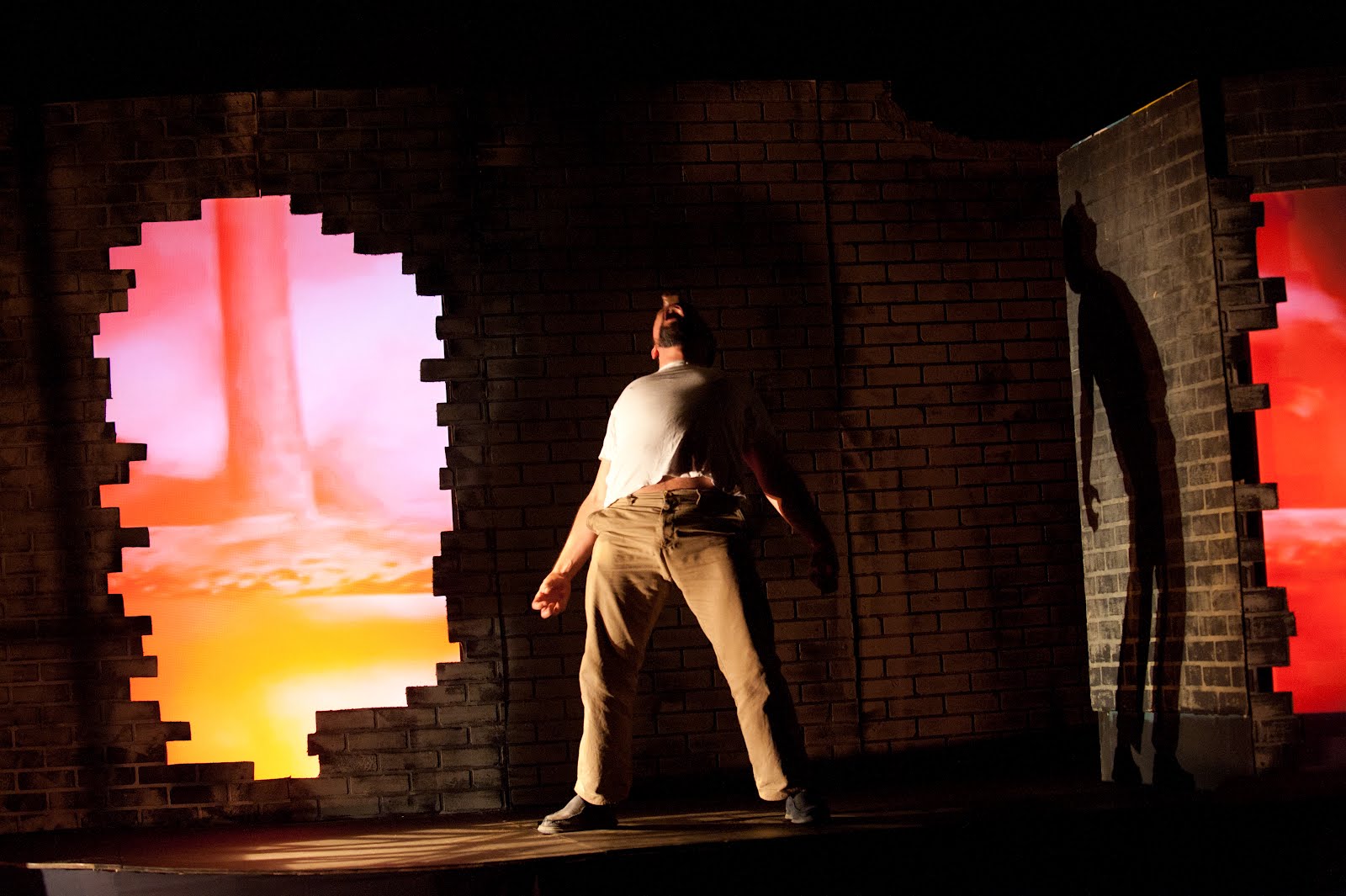
This month I wanted to share some photos of Salvage Vanguard's set for our current production, CIVILIZATION (all you can eat). This set was built for a total of $275 smackers. I am not even exaggerating. We gave Connor (who designed) a bigger budget than that, but through the use of the co-op he was able to save the company ALOT of dough! The proof is in the pudding.

These images are from load-in, tech, and opening weekend performances... The build images are not the highest quality, but hopefully it gives you at least an idea... Check it out...

(production photos by Erica Nix, Jude Hickey and Florinda Bryant pictured)

Jenny Larson, Salvage Vanguard Theater/ Scenic Co-op


Friday, February 3, 2012

Thoughts from a Playwright writing for Kids

One of the many lessons I’ve learned as a Teacher is that Ido just as much homework as my students (if not more); I want them to passtheir tests every bit as much as they do, and I’m constantly worried about myperformance in class… only from the front of it instead of crammed behind asingle-seater desk. I’ve also learned there’sno way to prove these truths to my students, and that’s probably for thebetter.
What I didn’t knowuntil this week is that all those nervous jitters I got as an aspiring middleschool thespian during the first table readings of a new play are all still therewhen you’re the adult who wrote the play (only even more nervousy and morejittery.). Attending the firstread-through of the play I wrote specifically for the talented kids at Fairview,I was a big blob of anxiety.
What if they don’t like it?
What if they don’t like me?
Why didn’t anyone laugh at that line?
Who wrote this trash?
That kid is super talented, I hope I wrote a good enoughpart for her.
OH MY GOD A TYPO!!!!
As we all sat in a circle and took turns reading line byline, with everyone getting equal opportunity to speak (Socialists!), I became hyperaware of what in the script was working and what wasn’t. It reminded me of atime that Devon (Northlight's Director of Education) commissioned me to write a play for her theater company, Dogand Pony. Due to circumstances outsideof the control of the Theatre Gods, they needed a playwright, and needed onefast. I was hired last minute, andturned in a first act in just under seven days, a second act in three. At thatfirst read through, with seasoned professionals, I was nervous, sure (thescript hadn’t even been spell checked), but I knew if the whole thing fellapart on the table, everyone there would understand and have the tools to helpme put it back together. They were,after all, “lifers” who understood the often crazy nature of the business. Everyone at the table that night was fluentin a theater vernacular that would allow me to verbally sand over any of theiranxieties about the hurried outline I’d dropped in front of them and said“Okay, perform this!” I could explain itaway. I could say, “Don’t worry, thatpart’ll beef up in act two.” Or “Thatmonologue is really short-handed now. It’s more of an outline for what I wantit to be after I’ve spent more time with it,” and all would nod knowingly andtrustingly.
Fools.
But kids, on the other hand, are not fools. And especially not these kids. And they’ve not yet developed the theatervernacular that allows me to explain away any of the textual issues they mayhave with the script. If somethingdoesn’t work on the page, I’m going to hear about it. Immediately. With my old bones sat on the floor in a spirit circle, every kid’s eyestrained on this thing they’d been anticipating since the beginning of theschool year, I wondered how I might explain away any issues with the story, orcharacter arc, or lack of poetic plasticity. I mean, the best I could say would maybe be “This is gonna be fun. Trustme.”
But, at the end of the read through, they did trust me. And they did have fun. Many were excited, already talking with theirfriends about who wanted which parts and which were their favorite lines. I could have been there or not. The play’s the thing! And every young actor in that circle found atleast one character that she or he wanted to bring to life.
The students are going to have fun because they aredetermined to have fun. Almost as muchfun as this grumpy old playwright will have watching them bring it tolife. But, of course, there’s no tellingthem that.

by: Philip Dawkins - Playwright of Rodeo, a commissioned play for the Northlight On Campus program at Fairview South Middle School

Tuesday, January 31, 2012

Is the world going to end in 2012?

I woke up this morning knowing exactly what I wanted to blog about this month. Was I motivated by last night’s zombie dreams? Or was it the apocalyptic play I watched a couple of days ago? Maybe the looming fears that the Mayans were right? Or was it yesterday’s rehearsal for the show about the hopeless and inevitable collapse of civilization that motivated me? Well, it is probably all of those things a little bit, and then some more…

Is the world going to end in 2012?

I don’t know, and frankly I don’t really think so. The world will change, definitely. But end? And honestly I guess I am less curious about that question and more curious about how that looming thought, idea, and nightmare changes the ways we interact with one another.

Where am I going with this? Okay so I woke up this morning thinking about the goodness of mankind, and the kindness, and these almost revolutionary actions that are springing up from our current political and social climate on a national and international scale. There are grand and obvious actions like the Occupy Movement, but there are also these small ways, in our theater communities, that we are becoming less competitive and more harmonious. Across the country I see individuals and organizations making movements towards a more amicable and sustainable theater environment. The Scenic Co-op is obviously one example of this sort of movement. We share set pieces with companies who can’t afford to purchase everything new. We recycle set pieces so we can make some small difference on the growing landfills. But we are certainly not the only ones taking these revolutionary steps.

Just a couple of examples include: Polly Carl’s HOWLROUND. The HOWLROUND is all about conversation across the nation across budgets, across race, across aesthetic. Because of HOWLROUND our community is talking to each other more than they ever have before. Another example is Vjay Matthews and Jamie Gahlon’s New Play Map, which is a map of the country and all the new work happening across the fifty states. It’s another attempt at keeping us connected and talking to each other, supporting each other. There is also Austin New Works community, a collective of Austin theater makers researching sustainability and community. Instead of fighting for a piece of the pie, lets share the pie. There are really enough slices for everyone. The list of theater makers and artists taking these actions goes on and on with TCG Exchange, The Center for Sustainability in the Arts in LA, Materials for the Arts in New York City, MECCA in Oregon to name a few… I am thrilled by these actions being taken to do away with the idea of “haves and have not’s”. People are questioning hierarchy and actively trying to support each other.

This makes me wonder, if our imminent doom weren’t right around the corner would we be playing nice? I don’t know. I don’t even know if the why matters. My suspicion is, that hard times do drive people to the next best thing. I think these difficult circumstances do motivate beautiful transitions and transformations. It’s thrilling. We are actively researching and instituting these revolutionary ideas that all focus on a “coming together.” It is beautiful, and inspiring, and it gives me hope.


Jenny Larson, Salvage Vanguard Theater/ Austin Scenic Co-op


Tuesday, January 3, 2012

Building Confidence Through Mini-Performances

Post By: Kristyn Hegner, Northlight Teaching Artist
It is a delight to return to Fairview South Schoolfor the second year as a “NOC” teaching artist. Currently, we have just finished the first half of our yearlongresidency and are about to hold auditions for Philip Dawkins’s original play, Rodeo.

In our second year, NOC’s programming is continuing toevolve and grow in an effort to best serve Fairview’s students. Prior to our first class, fellow teaching artistMatt Farabee, intern Mara Stern, and myself met with Northlight’s Director ofEducation, Devon de Mayo to assess the strengths and weaknesses of last year’sprogram.

Through this dialogue, wetailored the curriculum, building upon previous experiences. Last year, we felt the students lackedself-confidence. This was demonstratedthrough struggles with projection, articulation and stage presence. WhenMatt and I revamped the curriculum, we decided that by having the students doat least one mini-performance each week we could fortify performance based skillswhile strengthening each student’s overall confidence. Throughout the course of the semester, we didjust that. Weekly, the students wroteand performed original scenes, improvised short plays, and as a culminatingactivity performed a fully memorized monologue. During the weekly classes, students were given the challenge to act aspeer directors, modeling and applying their knowledge and growing skill set inan effort to encourage their fellow students. Throughout each performance, peers were encouraged to watch for specificnotes that were then administered through constructive feedback and reflection.

It has been inspiring to watch our veteran students act asleaders, demonstrating their growing theatricality, and in turn, it is equallyas thrilling to watch our newest members take on new challenges. I am looking forward to working withour students as we embark together on Rodeo. Fairview students are very proud to bemembers of NOC. I know they are readilyawaiting auditions, rehearsals, and finally, sharing the culminatingperformances with their friends and family.

Kristyn Hegner has spent four summers teaching at Northlight’sPerforming Arts Camp. She is in her second year as the lead teachingartist to pilot Northlight On Campus at Fairview South School. Agraduate of Indiana University, Kristyn studied Theatre with minors in Englishand Psychology. Kristyn also teaches with Dream Big Performing ArtsWorkshop, American Theatre Company and has assistant directed and choreographedmultiple children’s productions, and lead several dance and movement intensiveworkshops.

Wednesday, December 28, 2011

Money for nothing and your rehearsal space for free?

Over the last year Connor and I have been engaged in research with the Austin theater community with a focus on resource sharing. We divided our areas of research up into: stuff, space, and staff (or people, things, and places). With each area we did interviews and surveys and national research on other models of sharing that we may be able to borrow ideas from.

In our “space” research I talked to people around the nation, to find out what everyone else was up to, and Connor surveyed the Austin community to find out what peoples needs and wants were here in our home town.

Connor discovered that people primarily felt that the community needed more rehearsal space above all else, but it wasn’t just rehearsal space people wanted. They wanted free rehearsal space, with air conditioning, sprung floors, mirrors, space to leave your belongs, etc etc etc… the list of rehearsal space desires was quite long. As Connor shared the list with me I thought, “Yes, yes, yes, I want these things and need these things too! Rehearsal space is a nightmare to find in Austin! We need to do something about this.” Simultaneously, as an administrator who runs a venue, I found myself questioning why people think they should get this space for free?

There seems to be this sense of entitlement amongst artists in my community. I do believe, hence the Scenic Co-op, in sharing resource. I do believe, also the proof is in the pudding with the Co-op, in affordable resources. However, I may set myself apart from the larger community in that I don’t think free is a feasible option.

My admin brain wanders to questions like “who will pay to build or refurbish this rehearsal space? And who will then take care of it? And schedule it? And clean it? And shouldn’t we pay the person who helps to keep the place nice? How do we find that money? How do we pay to keep the lights on and the A.C. working?” I think that this money has to be found amongst the people who are using the space. This sort of entitlement goes beyond the rehearsal space conundrum, and when I was in my early twenties nurturing my own fledgling company I also thought “you want me to pay what for that?” about pretty much anything from performance venue to costumes and on and on and on… as I have grown up, my understanding of how expense producing theater is has grown up as well.

All that to say, there are a lot of young and inspiring artists in Austin and these artists are poor AND these artists are bringing some of the most exciting work to our city. Scratch that, these artists are bringing some of the most exciting theatrical work to our entire field, on a national level. So where is the balance? How much should these artists have to pay for a rehearsal space? Especially if that cost ends up being a deterrent to the creation of the work?

Currently Connor and I are launching a membership system for the Scenic Co-op. Participating companies will be expected to pay a low annual rate and in exchange they will have access to the full Co-op stock. So far, we have had a lot of companies interested in signing up but no one is jumping up and down about it. Primarily because up until this year the Co-op has been 100% free for a large amount of Austin area new works theater companies. In the long run though, we need a little give back from these companies if the Co-op is going to sustain. We need to pay staff. We need to keep the tools working and in top shape and to keep our stock up to date and in good condition.

I don’t write this because I have answers, I only have questions… how do you get your money for nothing and your rehearsal space for free?


Jenny Larson

Salvage Vanguard Theater

Scenic Co-op

Wednesday, December 21, 2011

Connecting to Writing through Theater

Having been in the New Orleans school system for a number of years now I know that students struggle with one thing more than any other: writing. Many low-income students in charter schools here just don’t have much experience writing, and feel intimidated by the process. It’s tough. It’s especially tough to get students to write creatively and openly when they feel unsure about their skills. As we know, the creative process is hard if you feel worried and nervous about how you’re going to be judged.

For YO NOLA, I’ve been having my students try out their hands at some playwriting, and they have really taken to it. A few of the students went home to continue the writing process there, and returned later in the week with freshly written work. It’s nice to see them connect to writing, and I think part of the reason for their enthusiasm is dialogue. They hear all sorts of interesting dialogue at home between parents, at school between peers, in the classroom, etc. Playwriting is a way for them to record this dialogue and to be creative with it. I have a full pile of plays about cell phones, bad classroom behavior, missed assignments, bad clothing, and on and on.

However, I really want them to go further, and here’s where the struggle comes in. Saying to a student, “use your imagination” has proved to be useless in my experience. It hardly ever results in a more imaginative product; just students feeling like they’re doing something wrong but unsure how to fix it. Like any artist, students need some fodder from which to be imaginative. As part of this quest to add to their writing repertoire, I’ve introduced something called “See, Think, Wonder.” Students look at a photograph, and have to write down three categories of things:

-Things in the photo they see and can point to.

-Something they think might be happening in the photo

-What do they wonder about? What questions doe they have about the photo?

Once students have brainstormed a whole bunch of see, thinks, wonders, they circle a question or thought of particular interest. This thought then inspires a short play. It’s an interesting process, and one that I’ve found creates some fun plays. Here’s the first few lines of a play by Sabria, who was inspired by a photo of a fog covered bridge I brought in. Her ‘wonder’ question was, “I wonder if there are birds on that bridge.” Then she wrote this:

Crow 1: Look, there is bird seed on that bridge.

Crow 2: Let’s go get some.

Crow 1: This is great.

Crow 2: Let’s tell the others.

Crow 1: Okay.

Crow 2: Our feet are stuck!

Crow 1: Wait, no they’re not. (tries to remove feet) Okay we’re stuck!

Crow 2: I knew it we’re going to die. Whoa is me, why , why!

Crow 1: Zip it earl.

Okay, that’s it for now. Happy Holidays all!

Chris Kaminstein

YO NOLA Teacher

Southern Rep Theater

Tuesday, November 29, 2011

Engaging Boys in Theatre


As we enter our second year at Fairview South School with Northlight on Campus (NOC), we have heavily considered the issue of connecting young boys with theatre.  We have a wealth of female participation, however boys remain a struggle to engage.  Last year, we started NOC with four boys, but over the course of the school year, lost all of them to other activities or a sense of pressure in being the only boys.  This year, we have four boys again to begin the program and already we have seen some apprehension. On the first day of NOC, one of our 6th grade boys stood in the hallway looking in as we began working. As we coaxed him in, he nervously asked if there were other boys, when we told him ‘yes,’ he made the choice to come in and join the group.

The hesitation of boys to participate in theatre is a pervasive pattern that we notice in many of our theatre education programs. Curious about why male involvement in theatre (especially in the junior high grades) seems taboo, even in 2011, we asked some men in the theatre for their thoughts.
 Northlight’s Artistic Director, BJ Jones, recalled a story about a nun at his Catholic elementary school, who humiliated him, at the age of ten, in front of his peers when she found him carrying a play in his pocket. “She waited for the whole class to get seated, and then announced to everyone ‘Mr. Jones is a thespian.’  I didn’t know what the word even meant, but I knew it was demeaning.  Any boy who thought he might ask me about what I did on the weekends and after school in theatre classes was never going to ask me now.”  Northlight Teaching Artist Michael Leon had a similar experience growing up in a Cuban family.  “My opinion is that boys and men are raised and expected to be unexpressive and non-emotional. The way they present themselves to others should be strong and contained. This may be an old fashioned way of looking at things but I feel that a lot of parents still raise their kids like this.”

Philip Dawkins- a Chicago playwright, currently writing an original work, Rodeo, for NOC at Fairview- talks about gender expectations by comparing young adult literature for males and females. “Look at YA reader romance geared toward girls. Lots of story. Lots of relationships. Drama.  Look at the YA reader romances geared toward boys…  There are none… While young girls are reading Sweet Valley High, young boys (even young soon-to-be-gay boys) are searching under their fathers' beds for back issues of Playboy…A group of people who get together and act out long-winded scenarios about relationships and wants and desires?  Sounds more geared toward people whose fantasies were fueled by Sweet Valley High.  The hustle and bustle of the basketball court, competition, physical contact, rage, immediate gratification or disappointment:  Playboy.”

In our quest to engage boys in theatre, we have seen amazing support from the male teachers at Fairview. One 8th grade teacher, told an assembled audience of 7th-8th graders a story about being a male in high school theatre. Even though he was an athlete, one of the best experiences he had in high school was acting in a school play. He auditioned in order to impress a girl, but once he got cast, and she didn’t, he decided to stick with it and said it was one of his greatest memories of high school.

BJ Jones recognizes what participating in theatre meant to him as a young boy: “There is a stereotype, but it saved my life. I would have never left Cleveland, would probably be sitting at a neighborhood bar next to my uncles.  Instead, theatre got me out.”